
Many students — and many parents — share the same first question about SAT Reading & Writing: Where do we start? R&W feels less straightforward than Math because it draws on long-developed language skills. But once you understand what the test is measuring and follow a clear plan, getting started becomes much easier.

Many students—and parents—start with the same question: Where do we begin with SAT Reading & Writing?
Unlike Math, R&W can feel less straightforward because it draws on years of language development. But once you understand what the test measures and follow a clear plan, the path becomes much simpler.
1. Start with a Clear Overview
For younger students—or those who need a less intimidating starting point—begin with a basic introduction to the test. Khan Academy offers a simple overview of question types and format, with leveled practice.
- Khan Academy – SAT R&W: https://www.khanacademy.org/test-prep/sat-reading-and-writing
Note: It’s not comprehensive, and most of its questions also appear in the College Board question bank, so students can skip it if they prefer to go straight to official practice.
2. Build Your Prep Around Official Materials
From there, shift quickly to official resources. Nothing is more accurate than the source itself.
The College Board provides full-length tests (via Bluebook) and the large College Board Question Bank—both free. These should form the backbone of any study plan.
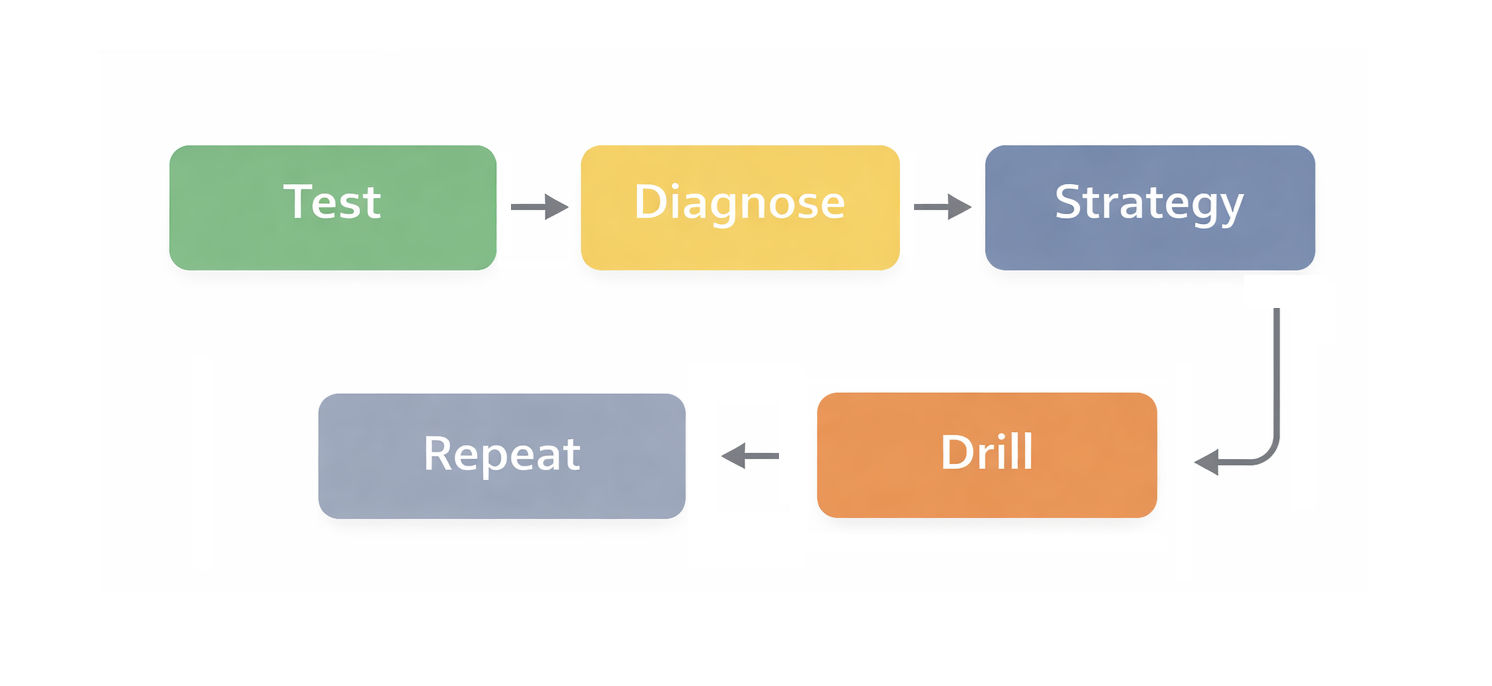
A simple, effective cycle:
- Take a full test
- Identify weak areas
- Drill those areas in the question bank
- Repeat
If a student hasn’t fully used these materials yet, there’s no need to buy anything else. The value and accuracy here are unmatched.
- Full Tests (Bluebook app): https://bluebook.collegeboard.org/students
- Official Question Bank: https://satsuitequestionbank.collegeboard.org/
3. Supplement with High-Quality Books (When Needed)
There are hundreds of SAT books out there, but only a few stand out. Two of the strongest are by Erica Meltzer, widely respected for her clear explanations.
- The Critical Reader (Reading): https://www.amazon.com/dp/B0F251W1PB
- The Ultimate Guide to SAT Grammar: https://www.amazon.com/dp/1733589597
As a general rule, avoid most big-brand prep books, as they often rely more on marketing than on instructional quality.
4. Train with Extra-Hard Tests
One common issue: many practice tests online—and even some official College Board ones—are easier than the current SAT. This can lead to inflated expectations and a shock on test day. Among official materials, the most recent Bluebook Practice Test #11 comes closest, and #7 is also excellent, but others are less reflective of current difficulty.
That’s why I built PreppedSAT.com: to give students practice at or above real test level. Every R&W question is written by me to match the precision and difficulty of the actual exam.
Over the past three years, these extra-tough tests have helped thousands of students reach top scores.
Try a full practice test for free here and see for yourself:
- Prepped extra-tough SAT platform: https://preppedsat.com
5. Don’t overlook vocabulary
Vocabulary quietly drives performance across the entire section. Students who recognize high-frequency academic words read faster, make fewer errors, and handle harder passages more confidently.
The SAT repeatedly draws from a relatively consistent set of Tier-2 academic words. Learning these directly is one of the highest-return investments a student can make.
For structured study:
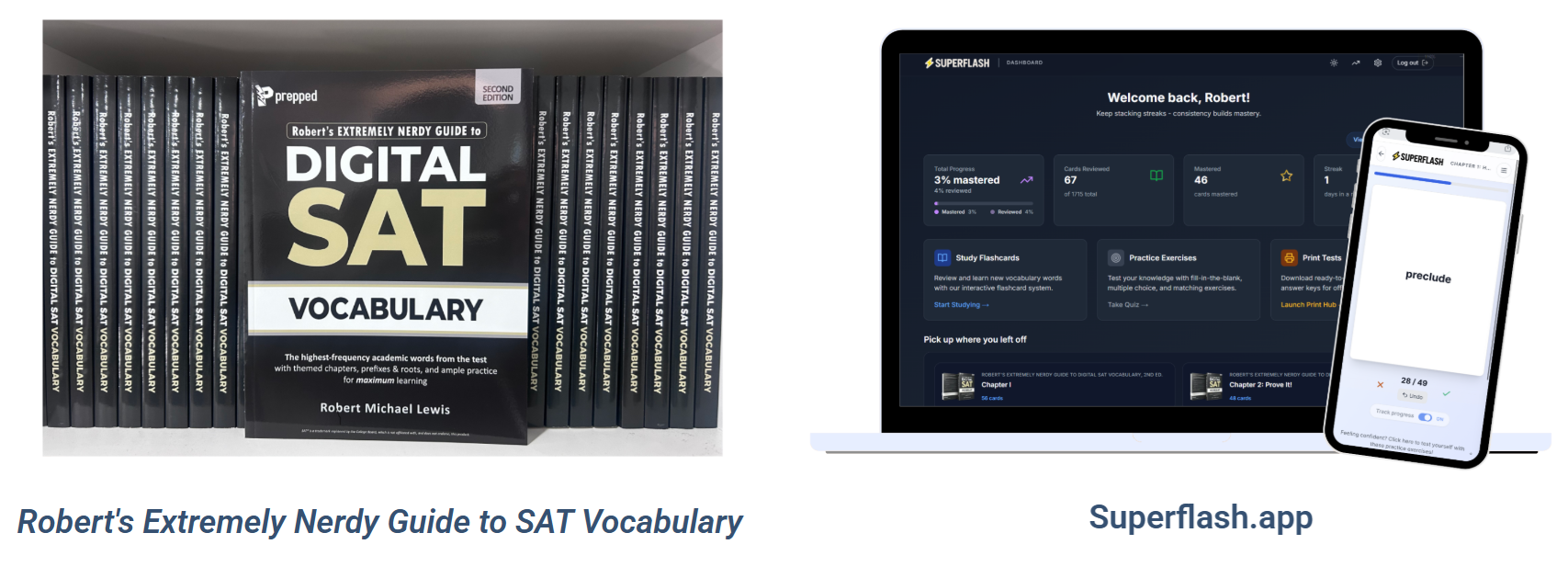
- Robert’s Extremely Nerdy Guide to Digital SAT Vocabulary: https://www.amazon.com/dp/8996955264
On the March 2026 SAT alone, 36 tested words were already covered in the book, including: amenable (Chapter 18), analogous (23), anomalous (V, 7), authoritative (15), compromise (1), concurrent (24), cryptic (6), detrimental (1), emulate (7), ephemeral (24), exemplar (8), expedite (1), haughty (13), hinder (1), inconsolable (20), induce (25), irrespective (23), lethargic (16), misconstrue (12), multifaceted (II), multifarious (II), obstinate (14), perfunctory (14), pertinent (1), prevalent (9), protracted (24), refute (2), retrospect (I, 24), scrutinize (2), substantiate (II.2), supersede (23), supplement (22), tantamount (23), ubiquitous (9), unequivocal (I.5), and untenable (VI, 2).
For interactive practice, I’ve also created a flashcard platform based on the words in Robert’s Guide:
- Superflash vocabulary platform: superflash.app
A final word
If you follow this structure—official practice, deep review, targeted drilling, and the right supporting resources—you’ll have a clear, effective path forward.
And if you’re unsure where to start or what to prioritize next, feel free to reach out. I’m always happy to point students and families in the right direction.